
735 Main Rd, Edgeworth,
NSW, 2285


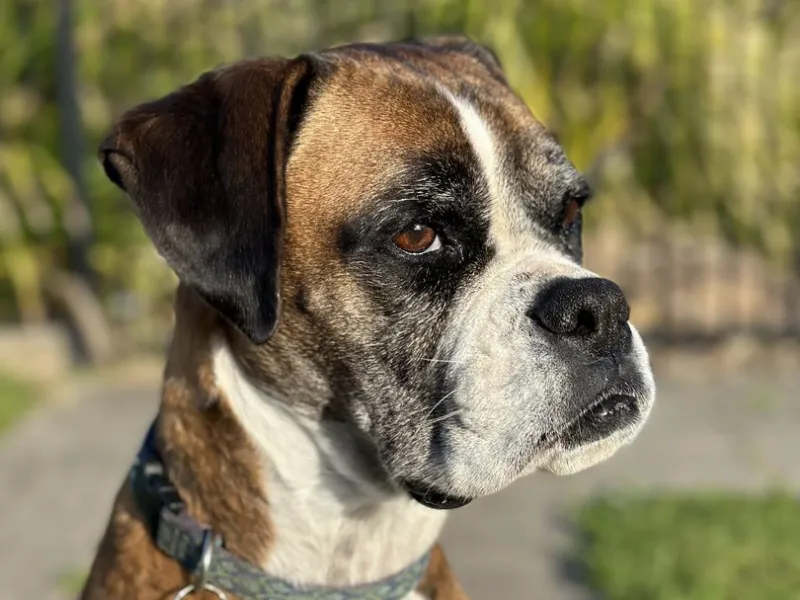
A Common Condition for Boxer Breeds
Tilda is an 8-year-old Boxer with gingival hyperplasia (GH). Her breed is unfortunately quite prone to it. She’s also a much-loved member of Dr Nicole’s family, and she’s had close monitoring of her condition and consistent follow-up throughout her life.
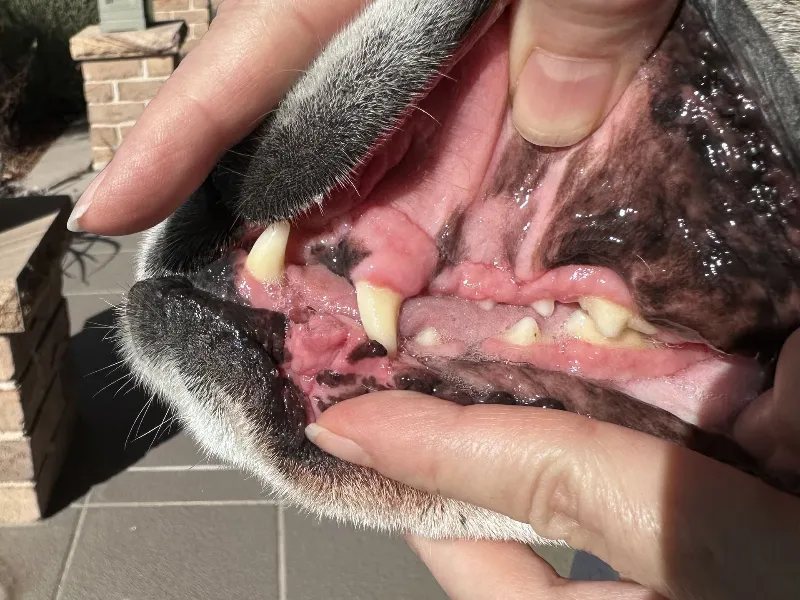
GH involves an overgrowth of the gum tissue that can partially cover the teeth and lead to discomfort, bleeding when chewing, and areas where plaque can build up easily. These pockets are different to those seen in periodontal disease. There’s no loss of attachment. Instead, excess tissue sits over the tooth surface, making it difficult to manage with normal home care, like brushing a pet’s teeth. Over time, halitosis (bad breath) and gingivitis become more noticeable, which then makes the condition even worse.
“Gingival hyperplasia creates a challenging environment where excess tissue traps plaque and accelerates periodontal disease”
Treatment and Ongoing Care
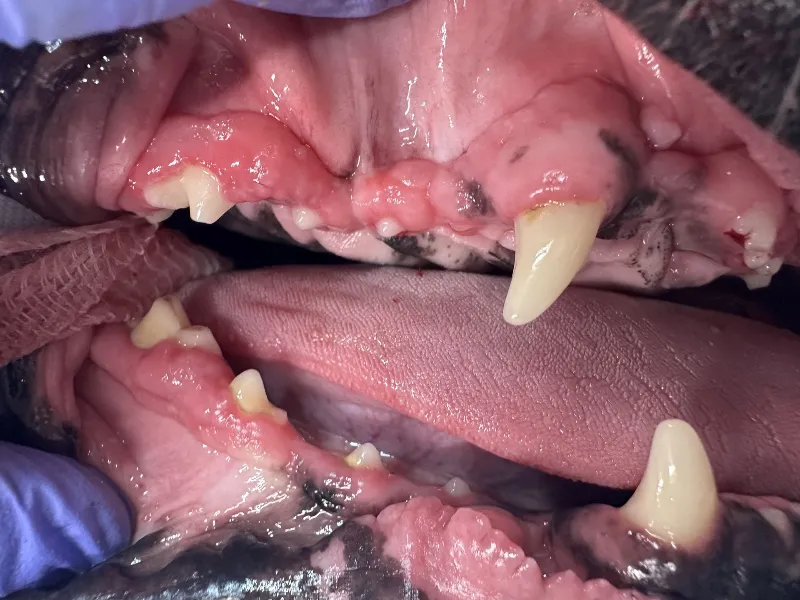
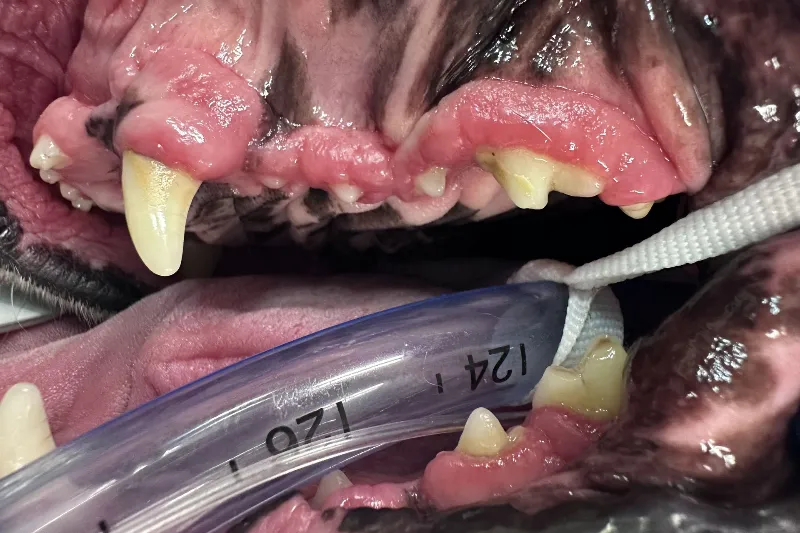
Tilda comes in for regular scale and polishes every 6–12 months. In these photos, it had been about 8 months since her last treatment. Even at this stage, we were already seeing changes, although many of the cases we see are far more advanced. When it’s left too long, the gum overgrowth can become quite severe and, in some cases, can cover the teeth almost completely.
In the before photos, you can see plaque and calculus on the teeth, along with gingivitis and gingival hyperplasia. She then had a scale and polish, along with removal of the excess gum tissue (gingivectomy) and reshaping back to a more normal contour (gingivoplasty). This is done using a combination of radiocautery and careful scalpel work to avoid any heat damage to the teeth. Patients like Tilda are given good pain relief afterwards, but gum tissue heals quickly, so most are back to normal within a few days.
Tilda also had a SANOS application this time to help reduce plaque build-up under the gumline, which can extend the benefits of a professional clean for up to six months. The difference so far has been impressive! At six weeks post-treatment, her gums are much less inflamed than they have been at this point after previous dentals. It’ll be interesting to see how that compares again at the six-month mark.
Dr Nicole reports that Tilda’s not particularly cooperative with tooth brushing, so at home she uses a mix of water additives, oral gel (MaxiGuard), and dental chews to help manage the gingival hyperplasia and maintain good oral health.
Ongoing Signs and Management
Tilda’s family usually knows it’s time for her next treatment because they smell it first. In fact, some of them will start complaining about her breath until she’s booked in. Along with that, there can be gum bleeding and some changes in how she’s chewing.
After treatment, she’s a much, much happier dog, and the difference in her breath is appreciated throughout the household. Tilda will continue with regular dental procedures under general anaesthetic, typically twice a year, to manage her condition.
“Successful outcomes in gingival hyperplasia cases rely not just on surgical correction, but on ongoing dental care and consistent plaque”
More Than a Dental Check
In addition to keeping her gingival hyperplasia in check, as Tilda gets older, her regular dental procedures under anaesthetic also create a good opportunity for a thorough look over and to assess any unusual lumps. This has already proven to be a real advantage for her.
She had a small, inconspicuous lump on the inside of her ear, in a spot that was difficult to properly assess while she was awake. It had been put off for a couple of months because of this. During her dental, it was removed. It turned out to be a mast cell tumour, which is a common cancer in Boxers. It required wide margins, which meant a fairly large section of tissue had to be taken, but it was still possible to preserve the ear. The results came back as low grade with clean margins, so no further treatment was needed.
After some reconstruction, the ear has healed well and looks quite good considering what was involved. It’s an important reminder that small lumps that seem insignificant can become much more serious if left too long. In this case, any further delay likely would have meant needing to remove the ear entirely.
It also highlights how helpful it is to be aware of the conditions certain breeds are more prone to, so changes can be spotted and acted on early.
Veterinary Services
Trusted veterinary care across every life stage, from vaccinations and surgery to diagnostics, dental, and exotic care.


Frequently Asked Questions
What is gingival hyperplasia in pets?
Gingival hyperplasia often presents as an overgrowth of gum tissue that can partially cover the teeth. This may lead to bad breath, bleeding when chewing and visible swelling around the gums. In many cases, plaque and calculus build up more easily due to the excess tissue.
What symptoms indicate a pet may have gingival hyperplasia?
Common signs include swollen or enlarged gums, bleeding, difficulty eating, bad breath, and visible gum tissue covering the teeth. In more advanced cases, pets may show pain or behavioural changes due to oral discomfort.
How is gingival hyperplasia treated and why does it involve ongoing care?
Treatment typically involves a professional scale and polish, followed by removal of excess gum tissue through procedures such as gingivectomy and gingivoplasty. These are performed carefully to reshape the gums and improve access for cleaning. Veterinary care also includes pain relief and monitoring during recovery. Even after treatment, the gum tissue can regrow over time, which makes regular follow-up important. Ongoing dental care helps manage plaque build-up and reduces inflammation. Without consistent monitoring, the condition can progress and become more severe.
How often should dogs with gingival hyperplasia have dental procedures?
In Tilda’s case, dental procedures are performed approximately every 6 to 12 months, depending on how her condition progresses. Some dogs may need treatment more frequently if signs such as bad breath or gum changes return sooner. Regular assessments help determine the most appropriate schedule.
Can dental procedures help detect other health issues in dogs?
Yes, dental procedures performed under anaesthetic allow a more thorough examination than is possible when a dog is awake. In Tilda’s case, a small lump was identified and removed during a dental, and later diagnosed as a mast cell tumour. This highlights how veterinary care can support early detection of other conditions.

Google Rating
4.7

I would like to say a massive thank you to Dr Nicole and the rest of the team for fitting in our dog for a torn dew claw this morning on such short notice. Ashlee on the phone was so lovely and quick to make the appointment for me. Our girl was treated with such care and we are very grateful 💕
Tiarna H.
Google Rating
4.7
Best vets I’ve ever been to with rabbits! Vet was so kind, gentle & knowledgeable. She not only looked after the unwell bunny, but also took our other bunnies at home into consideration. All staff were so helpful. The follow up phone call & sympathy card were so appreciated & such a beautiful touch. Will never take our pets anywhere else after such an amazing experience! 🩷
La fee
Google Rating
4.7
I was referred to Edgeworth vets as they have experience with bunnies and took my rabbit Ross there, he was old and not able to be saved so I had make the hard decision to have him put to sleep. The staff there were so kind and the vet I saw Kimberly was amazing. She was very kind and supportive and so gentle with Ross. I was able to stay with him while he passed and she talked me through everything. I’m so grateful to them that they helped Ross pass in a peaceful manner and cannot recommend them highly enough.
Katherine J.
Google Rating
4.7
Got recommended this business today for a very sick bunny, they got her straight in and were amazing. They kept us updated with care and compassion and although we lost our beautiful girl they were amazing. Would highly recommend this business and staff.
Thank you for caring and trying to save our sweet girl.
Peta L.
Google Rating
4.7
Thank you for the compassion your staff provided on Friday. ALL your staff were so lovely to us. We weren’t a regular client but you guys accommodated us, were empathetic and helped us in a really difficult time. I’m so thankful that I called and would highly recommend this veterinary service.
Jon B.
Google Rating
4.7
Booked it our new kitten for his first vet visit after we purchased him. The staff was so helpful and nice, plus they help us out after he did not enjoy the car trip very much. But they made him feel welcome and helped me out. The vet we sure was so helpful and answered all our questions. They even gave us a little info pack about our kitten etc. They were recommended to us by a good friend and I would 100% recommend them to anyone that has a pet that needs a caring vet.
Ian K.
Google Rating
4.7
These guys truly care. I couldn’t get my rabbit into his usual vet, however, they took him. Unfortunately it was the end of the journey for Boris and they were helpful, compassionate and loving the whole way. I even got a sympathy card 2 weeks later. Thank you for your love and care.
Kristy H.
Google Rating
4.7
Fantastic vets, we have been bringing our chickens here for 3 years now and have no complaints. Recently moved our cats to Edgeworth as well. All vets we have seen here have been great as well as the vet nurses. The receptionists are very helpful, its a releif to walk in the door and know that our pets are going to be well looked after.
Annette F.
Google Rating
4.7
Thank you for the beautiful card and condolences to our family after losing a battle with Jet. She tried so hard and fought like a little champion that she was. Thank you for your ongoing support, care, advice, and strength you showed to us, so that we could be strong. Unfortunately, little Jet succumbed to her many health issues but is now pain free. We will be under Edgeworth Animal Hospital for all of feathered family members. I couldn’t have asked for more
Debbie H.
Google Rating
4.7
I had an emergency with my cat, and came without an appointment. I was seen straight away. Every single interaction I had with the lovely people at this vet was amazing. They are so kind and go 110% for your fur baby. They went above and beyond and made this cat dad feel like everything was going to be ok. I cannot thank them enough.
James D.

Contact Info


After-Hours Emergencies
Contact AREC(Animal Referral & Emergency Centre)
1300 838 669